
L1
Experience layer
Clinician console, patient portal, mobile application, self-service kiosks and queue displays — role- and specialty-aware.
Architecture
Microservice domains, event-driven exchange, tenant isolation by design and a vendor-neutral data model with no lock-in.
L1
Experience layer
L2
Workflow & rules engine
L3
Domain services
L4
Interoperability hub
L5
Data & sovereignty layer
L6
Resilience layer
Six isolated planes, one event bus, zero shared blast radius.
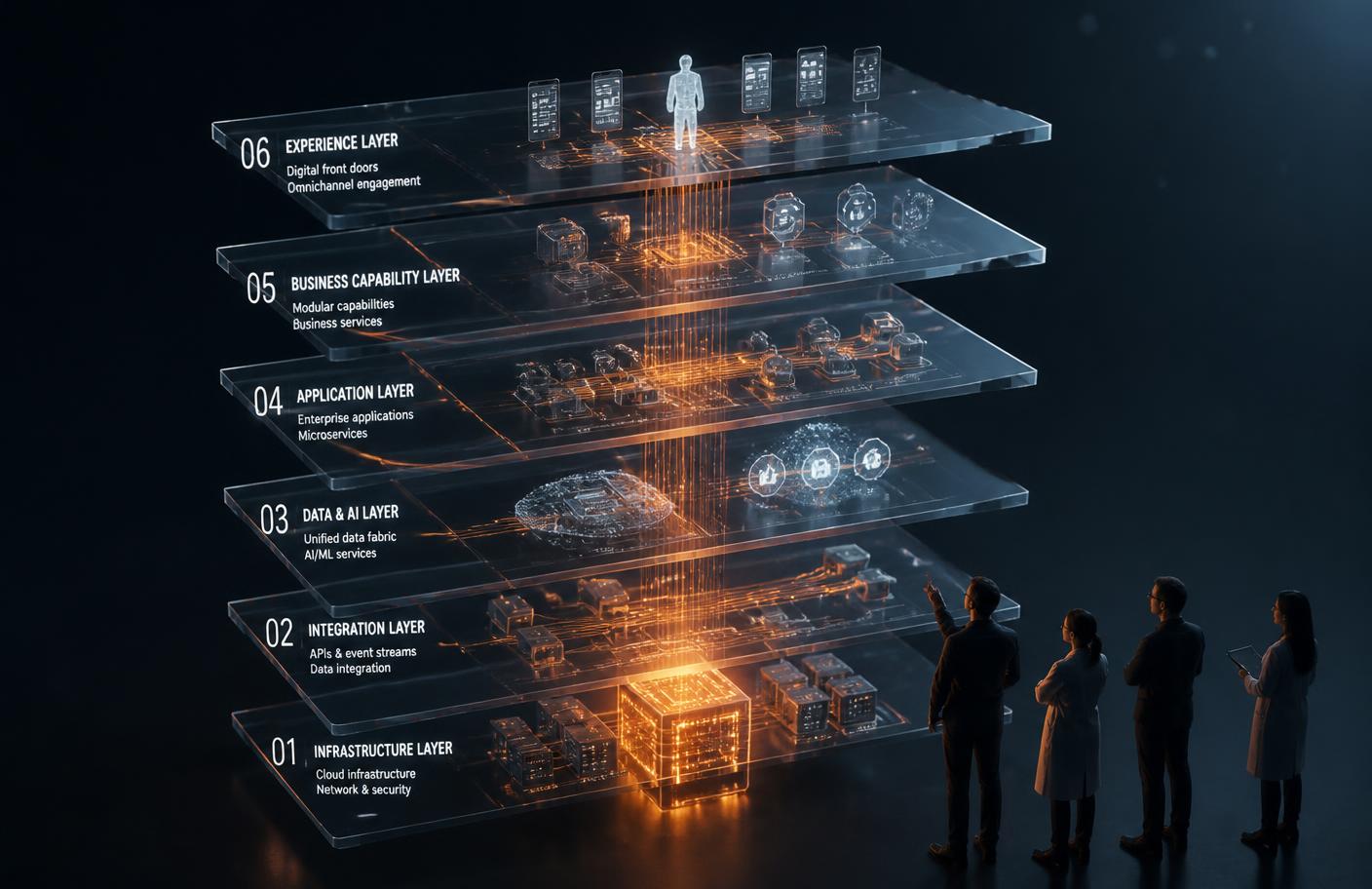
Architecture in depth
Six isolated planes, one event bus, zero shared blast radius.
L1
Clinician console, patient portal, mobile application, self-service kiosks and queue displays — role- and specialty-aware.
L2
Configurable clinical pathways, patient journey engine, task management and country-specific rule packs.
L3
EMR, LIS, RIS/PACS, pharmacy, theatre, billing, HR and supply chain as independently scalable services.
L4
HL7 FHIR R4, HL7 v2, DICOMweb, IHE profiles, terminology services and national health system connectors.
L5
Per-jurisdiction residency, tenant isolation, data lineage, warehouse, quality engine and governance catalogue.
L6
High availability, disaster recovery, offline/low-connectivity mode and humanitarian deployment profiles.
Delivery
Each phase is independently deployable and clinically validated before the next begins.